
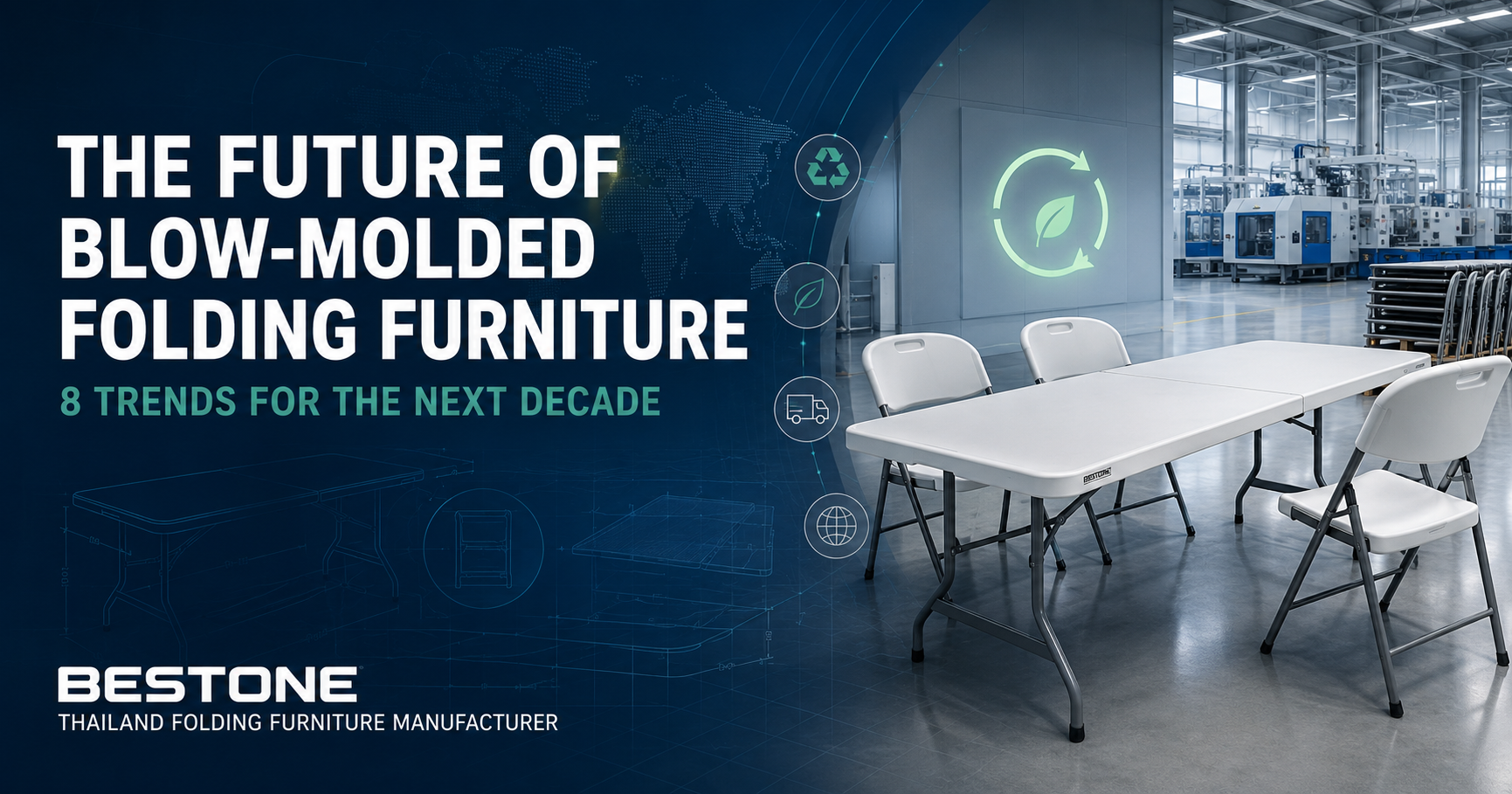
Blow-molded folding tables and chairs have been widely used in event rental, hospitality, education, catering, offices, churches, community facilities and residential environments for many years.
Their popularity is easy to understand. Blow-molded HDPE furniture is durable, portable, easy to clean and suitable for large-scale production. Folding designs also help distributors, rental companies and end users reduce storage and transportation space.
However, the industry is entering a new stage.
The next generation of folding furniture will not be defined only by lower prices or heavier products. Buyers are increasingly evaluating weight, durability, outdoor performance, transport efficiency, environmental responsibility, repairability and total ownership cost.
For manufacturers, this change creates both challenges and opportunities.
Here are eight important trends that are likely to shape the blow-molded folding furniture industry over the next decade.
1. Lightweight Construction Without Sacrificing Strength
Lightweight design will be one of the most important directions for future folding tables and chairs.
Commercial users frequently move, unfold, stack and transport their furniture. A table that is one or two kilograms lighter can make a meaningful difference when a rental company handles hundreds of units every week.
Lower product weight may provide several benefits:
Easier handling by one person
Faster event setup and removal
Lower physical strain on employees
Reduced freight and delivery costs
Improved e-commerce shipping efficiency
More convenient use for schools, churches and households
However, lightweight construction should not simply mean using less plastic or thinner steel.
Removing material without redesigning the structure can lead to tabletop deformation, unstable frames, damaged corners or shorter product life.
The correct approach is structural optimization.
Manufacturers need to study tabletop reinforcement patterns, wall-thickness distribution, steel-frame geometry, locking mechanisms and the connection between the tabletop and frame. Material should be concentrated in important load-bearing areas and reduced only where it does not contribute significantly to performance.
The objective is not to manufacture the lightest possible product. The objective is to achieve a better strength-to-weight ratio while maintaining commercial durability.
2. Greater Specialization for Different Applications
For many years, the market has been dominated by general-purpose folding tables and chairs. In the future, more products will be developed for clearly defined applications.
An event rental company, for example, has very different requirements from a household consumer.
Rental companies may prioritize:
Repeated folding performance
Fast setup and removal
Stable stacking
Resistance to impact during transportation
Replaceable feet and locking components
Compatibility with furniture carts
Easy product identification and inventory control
Hotels and banquet facilities may focus more on appearance, quiet operation, hidden mechanisms and compatibility with tablecloths.
Schools and public facilities may require rounded corners, pinch-point protection, adjustable heights and surfaces that are easy to clean.
Outdoor users may need UV resistance, corrosion protection and stable performance under changing temperatures.
As these markets become more professional, one standard product will no longer satisfy every type of buyer. Successful manufacturers will need to develop product platforms for specific industries rather than simply offering different sizes of the same table.
3. Improved Folding, Stacking and Transportation Efficiency
A folding product should save space, but folding alone is no longer enough.
Future buyers will pay more attention to the complete logistics system:
Folded product thickness
Carton size
Pallet configuration
Container-loading quantity
Warehouse storage density
Delivery vehicle capacity
Stability during stacking
Time required for loading and unloading
A small reduction in folded thickness can create significant savings when multiplied across a full container or a large rental inventory.
Manufacturers will therefore need to consider logistics efficiency at the beginning of the product-development process. Frame position, hinge design, handle placement and tabletop shape should all be evaluated in relation to packaging and loading.
The best future folding tables will not only perform well when opened. They will also form stable, compact and efficient units when folded.
For importers, this can reduce the landed cost per unit even when the product’s FOB price is not the lowest.
4. Higher Expectations for Outdoor Durability
The phrase “suitable for indoor and outdoor use” has become common in the folding furniture market. However, buyers are increasingly looking for more specific evidence of outdoor performance.
Outdoor conditions may expose furniture to:
Ultraviolet radiation
High temperatures
Temperature changes
Rain and humidity
Coastal salt environments
Surface contamination
Corrosion inside and outside steel tubes
These conditions affect both plastic and metal components.
HDPE tabletops may experience color changes, reduced impact strength or deformation if the material formulation and structure are not properly designed. Steel frames may develop corrosion if surface preparation, powder coating or tube protection is insufficient.
Future outdoor furniture programs are likely to require more clearly defined performance levels. Instead of making a general outdoor-use claim, suppliers may offer different options for occasional outdoor use, long-term commercial outdoor use and demanding coastal environments.
This development will make UV stabilization, accelerated weathering, corrosion testing and post-weathering structural testing increasingly important.
5. Responsible Use of Recycled HDPE
Recycled HDPE will play a larger role in the future of blow-molded furniture.
The potential advantages are significant:
Reduced consumption of virgin material
Lower dependence on petrochemical feedstocks
Support for customers’ sustainability objectives
New opportunities in government and institutional purchasing
More effective use of post-consumer plastic resources
But recycled material also introduces technical challenges.
Variations in melt flow, contamination, color, odor and material history can affect blow-molding stability and final product performance. High recycled content may contribute to unstable parison formation, inconsistent wall thickness, reduced impact resistance or stress cracking if the material is not properly controlled.
For this reason, responsible manufacturers should not treat recycled HDPE only as a method of reducing cost.
A professional recycled-material program should include:
Defined sources of recycled material
Incoming material inspection
Melt-flow and contamination control
Standardized blending procedures
Suitable antioxidants and stabilizers
Mechanical and impact testing
Batch identification and traceability
Clear recycled-content claims
The future market may contain several product grades. Premium commercial products may continue to use a high percentage of virgin HDPE, while hybrid products may combine virgin and traceable recycled materials. Other product lines may be designed specifically around higher recycled content.
The important issue will be consistency and transparency, not simply the highest possible recycled percentage.
6. Repairable and Replaceable Components
Commercial folding furniture is often used for many years. During that period, small components such as feet, handles, locking rings and frame connectors may become worn or damaged.
When these components cannot be replaced, an otherwise usable table or chair may need to be discarded.
Future product design will increasingly consider repairability.
This may include:
Replaceable table and chair feet
Serviceable locking mechanisms
Standardized screws, rivets and connectors
Replaceable handles
Detachable frame assemblies
Spare-parts packages
Simple repair instructions and videos
Repairable products can provide lower lifetime costs for rental companies, hotels, schools and institutional users. They also help reduce waste and strengthen long-term relationships between manufacturers and customers.
For suppliers, spare parts should not be considered an afterthought. They can become part of a complete commercial furniture support system.
7. Product Traceability and Digital Information
Digital development does not necessarily mean installing electronic devices inside a folding table.
For most commercial buyers, the more useful innovation is access to reliable product information.
A QR code or other product identifier could provide access to:
Product model and dimensions
Manufacturing batch
Production date
Material information
Assembly and folding instructions
Test reports
Cleaning guidance
Spare-parts information
Warranty registration
End-of-life recycling guidance
This can be especially valuable for rental companies and large institutions managing hundreds or thousands of products.
Traceability can also help manufacturers investigate quality issues more efficiently. Instead of relying only on carton labels or purchase records, the supplier can identify the relevant production batch and review its material, process and inspection data.
As environmental reporting and product-data requirements develop, manufacturers with established traceability systems will be better prepared to serve large retailers and international buyers.
8. From Individual Products to Complete Furniture Systems
The future of commercial folding furniture will involve more than selling individual tables and chairs.
Buyers increasingly need complete systems that help them operate more efficiently.
An event rental furniture system, for example, could include:
Commercial folding tables
Folding chairs
Table and chair carts
Chair connection clips
Stacking and protection accessories
Spare feet and locking components
Product identification labels
Cleaning and maintenance guidance
A hotel banquet system could include rectangular tables, round tables, half-round tables, serpentine tables and coordinated carts.
A school furniture system could provide adjustable-height tables, benches, chairs and storage solutions using compatible dimensions and components.
Manufacturers that understand the buyer’s complete operation can create more value than suppliers that compete only on the price of one product.
What Will Professional Buyers Expect From Manufacturers?
Over the next decade, international buyers are likely to evaluate folding furniture suppliers more comprehensively.
Price will remain important, but it will be considered together with:
Product weight and structural performance
Quality consistency during mass production
Repeated folding durability
Outdoor weather resistance
Container-loading efficiency
Packaging performance
Material traceability
Replacement-part availability
Testing capability
Factory compliance
OEM product-development support
This change favors manufacturers that combine production experience with engineering, testing and quality-control capabilities.
Preparing for the Next Generation of Folding Furniture
The future of blow-molded folding furniture is not simply about making existing products cheaper.
It is about creating products that are lighter, stronger, easier to transport, more durable outdoors, more responsible in their material use and easier to maintain throughout their service life.
At Bestone Plastic Folding Furniture Co., Ltd., we believe these changes will create new opportunities for importers, wholesalers, event rental suppliers, retailers and institutional buyers.
As a folding furniture manufacturer in Thailand, Bestone is developing its product and manufacturing capabilities around several long-term priorities:
Lightweight structural design
Commercial durability
Stable blow-molding production
Responsible HDPE material solutions
Outdoor performance
Efficient packaging and container loading
Replaceable components
OEM and private-label development
Product testing and batch-level quality control
Our objective is not only to supply folding tables and chairs. We aim to help customers develop practical product programs for their markets and distribution channels.
Looking for a Blow-Molded Folding Furniture Manufacturer in Thailand?
If your company is developing a new folding table or chair program, Bestone can discuss product dimensions, target weight, load requirements, material options, packaging, container-loading quantity and OEM customization.
We welcome inquiries from importers, distributors, event rental suppliers, retailers and commercial furniture companies.
Bestone Plastic Folding Furniture Co., Ltd.
Thailand Blow-Molded Folding Furniture Manufacturer
Website: www.bestonethailand.com
Email: peter@bestonethailand.com
WhatsApp: +66 99 446 8612